
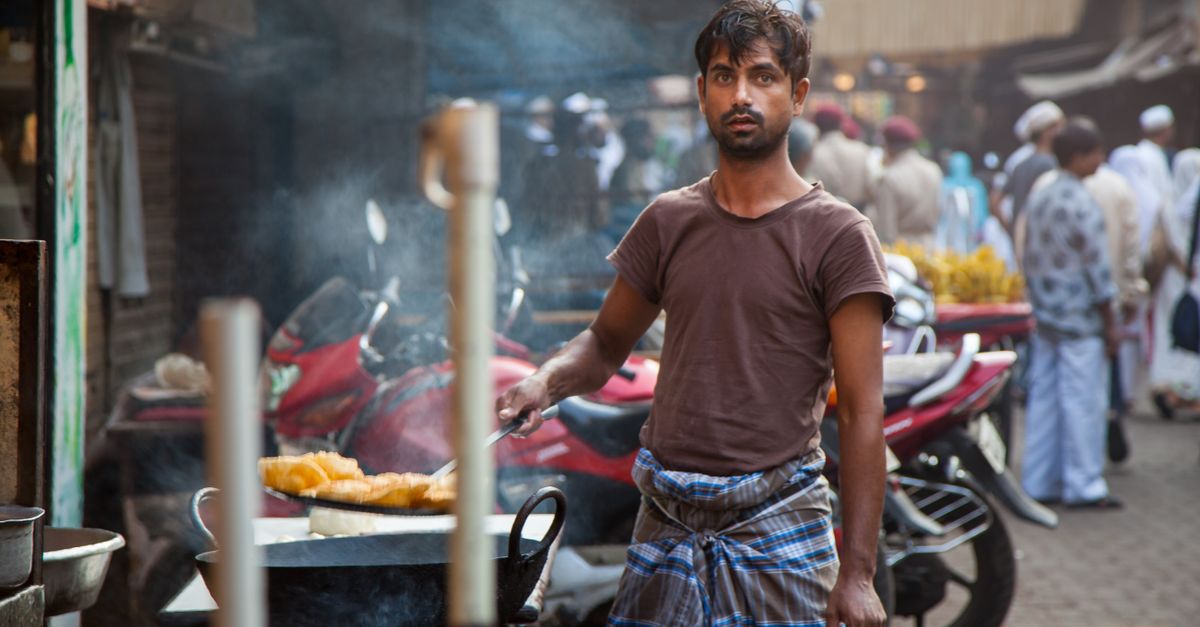
Mumbai is the city that never stops eating. This is not a figure of speech — it is a literal, observable fact. At 5 AM, the chai wallahs are already brewing their first kettles on street corners across the city, the sweet milky fragrance rising from a thousand tiny stoves as the newspapers land on doorsteps.
By 7 AM, the breakfast stalls are frying batata vadas and assembling misal pav for the morning commuters who eat standing up, one hand gripping a steel plate, the other checking their phone for the train schedule. The lunch rush hits at noon and doesn't let up until 3 PM, a wave of thali plates, biryani parcels, and dabba deliveries — Mumbai's legendary dabbawalas move 200,000 lunchboxes daily with an error rate that would shame a Swiss watchmaker.
The evening brings the street food vendors out in force — Marine Drive, Juhu, Girgaon Chowpatty, and a hundred smaller patches of pavement transform into open-air restaurants where the city gathers to eat bhel puri, pav bhaji, and vada pav as the sun drops into the Arabian Sea. And then, well past midnight, when most cities would have called it a night, Mumbai's late-night food stalls are still going: the kebab sellers on Mohammed Ali Road, the chai stalls near the train stations, the all-night dosa counters that feed the taxi drivers and shift workers who keep this insomniac city running.
What makes Mumbai's food culture unique is not just the volume or the hours — it's the diversity. This peninsula of 22 million people draws from every culinary tradition in India and beyond: Maharashtrian, Gujarati, Parsi, Mughlai, Goan, South Indian, Punjabi, Bengali, and a street food vocabulary that exists nowhere else.
The city invented vada pav — India's answer to the hamburger. It perfected pav bhaji — a dish born of textile mill workers who needed something cheap, filling, and fast. It adopted and transformed dishes from every community that arrived on its shores, creating a food identity that is aggressively its own.
This guide covers the essential dishes, the iconic restaurants, the best street food zones, and practical advice for eating your way through Mumbai without either a stomach upset or a depleted wallet.

10 Must-Try Mumbai Foods
1. Vada Pav (₹20-30)
If Mumbai had a coat of arms, it would feature a vada pav. This is the city's defining snack, its equaliser, its common ground — consumed by everyone from billionaires to construction workers, at every hour, on every street corner.
The concept is deceptively simple: a batata vada (a ball of spiced mashed potato, coated in chickpea flour batter and deep-fried until golden) tucked inside a soft pav (bread roll) with a smear of green chutney, red garlic chutney, and a fried green chili on the side. The execution, however, separates the good from the transcendent.
The vada must be crispy on the outside and fluffy within, the chutney must bite, and the pav must be fresh enough to compress slightly when you grip it. The best vada pav in Mumbai is the subject of fierce, never-ending debate.
Ashok Vada Pav near Kirti College in Dadar is a perennial favourite (₹20), as is the unnamed stall outside Andheri Station West that has been serving the morning commuter crowd for decades. Gajanan Vada Pav near Thane station is worth the journey for its perfectly seasoned filling.
At ₹20-30, vada pav is the cheapest great meal in India.
2. Pav Bhaji (₹80-120)
Pav bhaji was born in the 1850s as fast food for Mumbai's textile mill workers — a mash of leftover vegetables, heavily spiced with pav bhaji masala, cooked on a flat tawa with absurd quantities of butter, and served with soft, toasted bread rolls. What began as working-class fuel became a city-wide obsession.
The definitive version is found at Cannon Pav Bhaji at Girgaon Chowpatty (₹100), where the tawa is the size of a manhole cover and the butter is applied with the enthusiasm of a painter priming a wall. The bhaji is cooked for hours, reducing the vegetables to a thick, uniform mash where individual ingredients are no longer identifiable — just a wave of concentrated, spiced, buttery flavour.
Sardar Pav Bhaji near Tardeo is another institution (₹90), known for an even more butter-forward approach, if such a thing is possible. The Juhu Beach stalls serve decent versions (₹80) with the added atmosphere of sand between your toes and the Arabian Sea in front of you.
Pav bhaji is best eaten at night, standing up, with your second serving already on order before you finish the first.
3. Bhel Puri (₹50-60)
Mumbai's most addictive snack is a study in textural contrast: puffed rice provides the crunch, sev (thin chickpea flour noodles) adds crispy threads, chopped onions and tomatoes bring freshness, boiled potato adds substance, and two chutneys — sweet tamarind and sharp green coriander — tie it all together into something greater than the sum of its parts. Bhel puri is assembled to order by vendors who work with the speed and precision of sushi chefs, tossing and mixing in steel plates with bare hands.
The best bhel puri is at Girgaon Chowpatty (₹50), where the vendors have been perfecting their ratios for generations. Elco Market in Bandra (₹60) is the upscale alternative — served in a proper restaurant with air conditioning and slightly fancier presentation, but the same fundamental alchemy.
The key is freshness: bhel puri must be eaten within minutes of assembly, before the puffed rice absorbs moisture and loses its crunch. Anyone who eats bhel puri slowly has fundamentally misunderstood the dish.

4. Misal Pav (₹60-80)
This is Maharashtrian comfort food at its most assertive — a spicy curry of sprouted moth beans (matki) topped with a fiery rassa (thin spiced gravy), crunchy farsan (fried savoury mix), chopped onions, lemon, and coriander, served with pav for dunking and soaking. Good misal should make your nose run.
Great misal should make your eyes water while you reach for a second plate. Mamledar Misal at Thane (₹70) is widely regarded as one of the best in Mumbai, with a rassa that is genuinely volcanic.
In the city proper, Aaswad in Dadar (₹80) serves a superbly balanced version — spicy but layered, with the farsan providing essential crunch against the soupy rassa. Misal pav is traditionally a breakfast or brunch dish, eaten before noon, though Mumbai being Mumbai, you can find it at any hour.
5. Keema Pav at Olympia (₹180-220)
Olympia Coffee House on Colaba Causeway has been serving its legendary keema pav since 1932, and the recipe has not changed. Spiced minced mutton, slow-cooked with onions, tomatoes, and a proprietary masala blend, served with soft buttered pav that you tear and dip into the keema.
The meat is rich, slightly oily, and deeply savoury — the kind of dish that makes you close your eyes with the first bite. The cafe itself is a time capsule: Formica tables, ceiling fans, brusque waiters who have been working there for decades, and a crowd of regulars who occupy the same seats at the same time every day.
The akuri (Parsi-style scrambled eggs with onions and green chilies, ₹150) is also superb for breakfast. Olympia doesn't take reservations and doesn't need to — the turnover is fast and the queue moves.
6. Butter Chicken at Punjab (₹300-350)
Punjab Restaurant near Colaba has been serving Punjabi food to South Mumbai since the 1940s, and their butter chicken is a masterclass in the genre. The gravy is rich, slightly sweet, deeply tomatoey, and finished with enough cream and butter to make a cardiologist weep.
The chicken pieces are tender and well-marinated, holding their own against the sauce's intensity. Paired with garlic naan (₹60) or butter naan (₹50), this is the quintessential North Indian comfort meal. The restaurant's interior is basic — plastic chairs, fluorescent lighting, laminated menus — but nobody comes for the ambience.
They come because Punjab has been doing the same thing for eighty years and doing it extremely well. The dal makhani (₹200) is another must-order: black lentils slow-cooked overnight until they achieve a velvety, almost meaty consistency.
7. Parsi Dhansak at Britannia (₹400)
Britannia & Co. in Ballard Estate is not merely a restaurant — it is a monument to Mumbai's Parsi community and one of the most beloved dining institutions in India. Founded in 1923, the restaurant is still run by the Kohinoor family, and until his passing in 2021 at age 97, the patriarch Boman Kohinoor personally greeted every guest and insisted they try the berry pulao.
The dhansak (₹400) is the essential order: a Parsi dish of lentils cooked with mutton and vegetables, spiced with a blend that includes fenugreek, cumin, and cinnamon, served with caramelised brown rice. The texture is thick and porridge-like, the flavour complex and deeply satisfying.
The berry pulao (₹450) — fragrant basmati rice studded with tart barberries imported from Iran — is the other signature dish and perfectly complements the dhansak. The restaurant's décor includes portraits of the Queen, the Zoroastrian emblem, and old photographs of the family.
Go for lunch (they close early, around 4 PM) and arrive before 12:30 PM to avoid the worst of the queue.
8. Seafood at Trishna (₹800-1,200)
Trishna in Fort is Mumbai's definitive seafood restaurant, a tiny place with a massive reputation built on one dish above all others: the butter garlic crab. A whole crab, cracked open and swimming in a sauce of melted butter, garlic, and green chilies — it is messy, indecent, and one of the great eating experiences in the city.
A serving costs ₹800-1,200 depending on the size of the crab and the season. The tandoori pomfret (₹600) is another triumph — the fish marinated in a red masala and grilled in the tandoor until charred at the edges and silky within.
The koliwada prawns (₹500) — battered and deep-fried in a spiced coating unique to Mumbai's Koli fishing community — are addictive. Trishna is perpetually busy, the tables are crammed together, and the service is efficient but not leisurely.
Reservations are recommended for dinner, especially on weekends. This is the restaurant that spawned a London offshoot, and while the London version is fine, the original in a Mumbai side street is infinitely more alive.
9. Kulfi Falooda (₹80-120)
Mumbai's ultimate dessert is kulfi falooda: dense, slow-churned Indian ice cream (richer and denser than Western ice cream because it contains no air) served over falooda noodles (thin vermicelli), rose syrup, soaked basil seeds, and sometimes a scoop of ice cream on top. The best kulfi falooda in Mumbai is at Bachelorr's near Chowpatty (₹100 for the classic), where the kulfi flavours include malai (cream), pista (pistachio), mango (seasonal), and sitaphal (custard apple, the house specialty and available only from October to January).
The falooda noodles add a strange, wonderful chewiness against the frozen kulfi, and the rose syrup ties everything together in a fragrant, pink-hued indulgence. K. Rustom in Fort (₹80-100) is another institution, famous for ice cream sandwiches — slabs of kulfi pressed between two wafers — in flavours that rotate daily.
10. Cutting Chai (₹15)
Cutting chai is not merely a drink in Mumbai — it is a social ritual, a punctuation mark in the day, and arguably the city's true currency. The name refers to a "cut" (half) glass of tea — a small, intensely sweet, milky chai served in a glass tumbler.
The smaller portion means it cools quickly and can be drunk fast, which suits Mumbai's impatient rhythm. Chai wallahs are everywhere — outside train stations, on street corners, beside construction sites, next to office buildings — and the good ones develop fierce local followings.
The tea is brewed by boiling water, milk, sugar, tea leaves, and sometimes ginger or cardamom together until the liquid is thick, frothy, and almost orange in colour. At ₹15 per glass, it is the cheapest pleasure in the city.
Drink it standing at the stall, watching the city rush past. Return the glass. Move on. Repeat four to six times daily, as every Mumbaikar does.
Mumbai's Best Street Food Zones
Mohammed Ali Road
During Ramadan (dates shift annually with the Islamic calendar), Mohammed Ali Road transforms into Mumbai's most spectacular food carnival. After iftar (the evening breaking of the fast), the entire street erupts into a night market of food stalls serving dishes that appear only during this period.
Nalli nihari (slow-cooked lamb shank in a rich, spiced gravy, ₹150) glistens under bare bulbs. Malpua (deep-fried sweet pancakes soaked in sugar syrup, ₹40) are fried to order. Kebabs of every description — seekh, boti, galouti — smoke on charcoal grills.
Kheer and phirni (milk puddings) are served in earthen pots that add a subtle clay flavour. The crowd is enormous, the lanes are narrow, and the energy is unlike anything else in Mumbai.
Even outside Ramadan, the area around Minara Masjid is excellent for Mughlai food — Suleman Usman Mithaiwala for malpua and Noor Mohammadi for their famous nalli nihari (₹180).
Juhu Beach
The pavement stalls lining Juhu Beach form Mumbai's most iconic outdoor dining strip. The food is cooked on portable stoves and flat griddles, the seating is nonexistent (you eat standing or walking), and the view — sand, sea, sunset — is free.
The essentials: pav bhaji (₹80), bhel puri (₹50), sev puri (₹50), ragda pattice (₹60, crispy potato patties in a spiced pea curry), and pani puri (₹40 for a plate of six — hollow crispy shells filled with spiced water, potato, and chickpeas, consumed whole in a single messy, glorious bite). The stalls nearest to the JW Marriott end of the beach tend to be slightly more hygienic; the stalls at the Ville Parle end tend to be slightly cheaper.
Both are perfectly fine.
Girgaon Chowpatty
The southern, more refined cousin of Juhu Beach, Girgaon Chowpatty sits at the northern end of Marine Drive and has been Mumbai's favourite evening snacking destination for over a century. The bhel puri and pav bhaji stalls here are legendary — Vithal's and Guru Kripa are the two most famous names, both serving since the 1970s.
The kulfi falooda at Bachelorr's (mentioned above) is the essential dessert. During Ganesh Chaturthi (August-September), Chowpatty becomes the site of the city's most important Ganpati visarjan (immersion ceremony), when thousands of Ganesh idols are carried through the streets and immersed in the sea.
The atmosphere during this festival is electrifying — drums, chanting, colour, and an entire city in collective ecstasy.
Khau Galli (Ghatkopar)
Khau Galli — literally "Eat Lane" — is the name given to several food streets across Mumbai, but the most famous is in Ghatkopar East. This narrow lane is packed with stalls and small restaurants serving everything from Gujarati farsan (savoury snacks) to Chinese-Indian fusion to South Indian dosas. The dosa stalls here serve versions stuffed with cheese, paneer, Schezwan sauce, and combinations that would horrify a purist but delight anyone hungry.
The Manchurian (Indian-Chinese fried vegetable balls in a sweet-spicy sauce, ₹80) and frankie (Mumbai's version of a wrap — spiced filling rolled in a chapati, ₹60-100) are popular picks. Come hungry and prepared to queue.
Iconic Mumbai Restaurants

Leopold Cafe
Open since 1871, Leopold on Colaba Causeway is perhaps Mumbai's most famous cafe and a mandatory stop for travellers, not for the food (which is decent but not destination-worthy) but for the atmosphere. The bullet holes from the 2008 attacks remain in the walls, deliberately unrepaired.
The beer is cold (₹350 for a Kingfisher), the chicken tikka (₹450) is reliable, and the people-watching is unmatched. Leopold works best as a lunch or mid-afternoon stop — arrive during the dead hours between 3-5 PM for a seat without waiting.
Britannia & Co.
Already covered in the must-try section above, but it bears repeating: do not leave Mumbai without eating the berry pulao and dhansak at Britannia. This Ballard Estate institution closes around 4 PM and is closed on Sundays.
The waiters are elderly, the décor is frozen in time, and the food is irreplaceable. When this restaurant eventually closes — it has been under threat for years due to rent disputes — Mumbai will lose something that cannot be recreated.
Cafe Madras
Cafe Madras in Matunga is the temple of South Indian breakfast in Mumbai. This tiny restaurant has been serving dosas, idlis, vadas, and filter coffee to the Tamil and Keralite community since 1940.
The masala dosa (₹80) — paper-thin, crispy, filled with spiced potato, and served with sambar and three chutneys — is as good as anything you will eat in Chennai. The filter coffee (₹30) is brewed in the traditional South Indian way: decoction dripped through a metal filter, mixed with hot milk and sugar, and poured back and forth between two steel tumblers to create a frothy, aromatic drink.
Cafe Madras opens at 7 AM and the breakfast rush is intense — arrive early or be prepared to share a table. The uthappam (thick rice pancake topped with onions and chilies, ₹70) and the medu vada (deep-fried lentil donut, ₹40) are excellent secondary orders.
Cash only.
Bademiya
Bademiya behind the Taj Mahal Palace Hotel is Mumbai's most famous late-night kebab stall, operating since the 1940s from a tiny kitchen that sends out an improbable volume of seekh kebabs, chicken tikka rolls, and rumali roti parcels to a crowd that spills across the lane. The chicken seekh kebab roll (₹200) — smoky, spiced minced chicken wrapped in a thin roomali roti with onions and green chutney — is the quintessential Mumbai midnight snack.
The baida roti (₹180) — a paratha stuffed with egg and minced meat — is rich enough to serve as a complete meal. There is now a sit-down restaurant across the lane, but the original stall, with its chaos of orders shouted over the crowd and parcels passed hand to hand, is the authentic experience.
Best visited after 10 PM when the Colaba nightlife crowd arrives.
Budget Eating in Mumbai
Mumbai is one of the cheapest cities in the world to eat well. A full day of excellent food can cost under ₹500 if you know where to go. Breakfast: vada pav and cutting chai (₹45).
Mid-morning snack: samosa at any bakery (₹15-20). Lunch: a Maharashtrian thali at Aaswad in Dadar or any of the thali restaurants in Matunga — unlimited rice, two vegetables, dal, roti, papad, pickle, and a sweet for ₹150-200.
Afternoon chai: ₹15. Evening snack: bhel puri at Chowpatty (₹50). Dinner: a plate of keema pav at any Irani cafe (₹150) or a dosa at Cafe Madras (₹80).
Total: ₹450-550 for a day of genuinely excellent eating. Even at mid-range restaurants, a full meal with a drink rarely exceeds ₹500-600 per person. The only places where bills climb significantly are the hotel restaurants, the fine-dining establishments in BKC and Lower Parel, and the seafood restaurants where crab and lobster are priced by weight.

Practical Tips for Eating in Mumbai
When to Eat
Mumbai doesn't follow rigid meal times. Street food stalls operate from early morning until well past midnight. Restaurants typically serve lunch from 12-3 PM and dinner from 7-11 PM, but many iconic spots keep irregular hours — Britannia closes at 4 PM, Bademiya gets going at 10 PM, and Cafe Madras is best before 9 AM.
Check timings before making a special trip.
Vegetarian Paradise
Mumbai has one of the largest vegetarian populations of any city in the world, thanks to the significant Gujarati and Jain communities. The result is that vegetarian food here is not an afterthought — it is often the main event.
Some of the best restaurants in the city are entirely vegetarian. Look for the green dot on packaged food and restaurant signage to identify vegetarian establishments. Jain restaurants take it further, excluding onion and garlic — the resulting food is subtle, clean, and often surprisingly complex.
Tipping
At sit-down restaurants, check if service charge is already included in the bill (many add 5-10%). If not, tipping 10% is standard. At street food stalls, tipping is not expected but rounding up is appreciated. For dabbawala tips and chai wallah tips, ₹10-20 is generous and received with genuine warmth.
Plan your trip with our Mumbai 3-Day Itinerary →


