Hyderabad is India's undisputed biryani capital — a city where the dum biryani technique was perfected in Nizam-era royal kitchens and is now served at every level from street stalls to five-star hotels. But reducing Hyderabad to biryani alone misses the incredible haleem (a Ramadan favorite now available year-round), the double-ka-meetha dessert tradition, and the Irani chai culture that gives the city its most distinctive daily ritual.

Street Food & Markets: Hyderabad on the Footpath
Hyderabad's street food scene is among the most concentrated and historically rooted in India. The old city around Charminar operates as a continuous open-air kitchen from mid-morning until well past midnight, with vendors who have occupied the same spots for generations. The narrow lanes of Laad Bazaar, Madina Circle, and Pathergatti are lined with stalls that have traded recipes rather than menus, passing techniques from father to son across the same coal-fire grills for fifty years.
Pathar Ka Gosht (stone-cooked lamb, ₹150-200) is the most theatrical dish in the old city: marinated lamb beaten thin and cooked directly on a slab of granite heated over charcoal, picking up a smoky, mineral edge impossible to replicate in a conventional pan. The vendors work near Charminar in the evening, their granite slabs glowing orange under the minaret lights. The lamb arrives rolled in a paratha with raw onion and green chutney — a combination that has barely changed since the Nizam's era.
Sheer Khurma (₹40-80) — a thin, saffron-scented vermicelli pudding cooked in full cream milk with dates, dried figs, and cardamom — appears at old-city sweetshops throughout the year but reaches peak form during Eid, when family recipes passed through generations come out of private kitchens and into street-side distribution. Nimrah Cafe near Charminar serves an excellent year-round version alongside the customary Irani chai (₹15). Together they constitute the old city's most civilised mid-morning ritual.
The Madina Circle area transforms after 9 PM into one of the subcontinent's finest nocturnal food markets. Seekh kebab vendors (minced lamb pressed onto skewers and grilled over charcoal, ₹30-40 per skewer) operate alongside biryani cooks serving directly from giant handis, and kulfi vendors push carts stacked with mango, pistachio, and malai (cream) ice cream (₹30-50). The Hotel Shadab night counter stays open until 1 AM serving biryani, haleem, and kebabs at prices that make the nearby restaurant's slightly inflated tourist menu unnecessary.
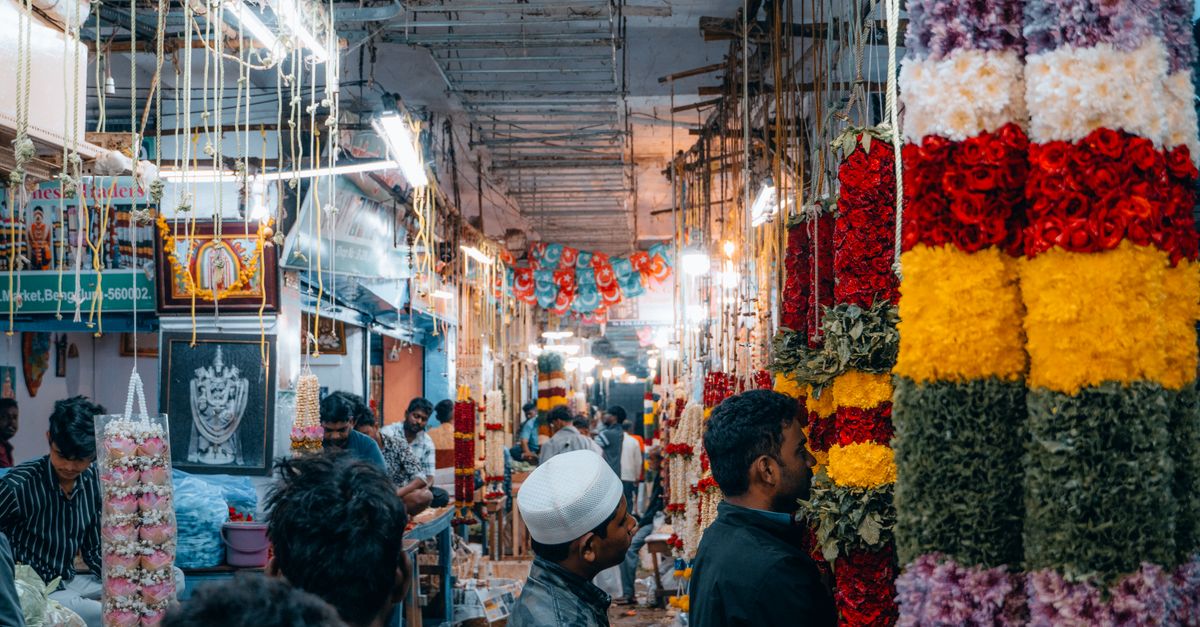
For a daytime market experience, Begum Bazaar is Hyderabad's wholesale grocery market and the source of the spice blends that define the city's cuisine. Stall owners will happily explain the difference between biryani masala and bhuna masala, and small quantities of everything — dried rose petals, kewra water, stone flower lichen (dagad phool) that gives Hyderabadi biryani its distinctive base note — can be purchased for ₹20-50 per packet. Cooking class operators based in Banjara Hills typically begin their market visits here before moving to kitchen preparation.
Must-Try Dishes
1. Hyderabadi Dum Biryani — ₹180-400
The king of Indian biryanis — basmati rice and meat (usually goat) layered with saffron, fried onions, and spices, sealed in a heavy pot (handi) with dough, and slow-cooked over charcoal (dum). The bottom layer (tah) is the prize — caramelized, crispy rice with concentrated flavor. Paradise (₹250-400) is the most famous. Shadab and Cafe Bahar in the old city serve more authentic versions (₹180-300).
2. Haleem — ₹150-250
Wheat, lentils, and meat slow-cooked for 8-12 hours until they merge into a thick, porridge-like paste — garnished with fried onions, lemon, and green chili. Originally a Ramadan dish, now available year-round. Pista House haleem is the benchmark (₹150-250). The texture is unlike anything else in Indian cuisine.
3. Double Ka Meetha — ₹80-150
Bread slices soaked in reduced milk (rabri), deep-fried, and topped with nuts and saffron — Hyderabad's signature dessert, a Nizam-era creation. Available at most biryani restaurants as the traditional finale. ₹80-150. Rich, sweet, and unapologetically indulgent.
4. Irani Chai & Osmania Biscuits — ₹15-25
Strong, milky tea served in glass cups with buttery, slightly salty Osmania biscuits — the daily ritual of old Hyderabad. Irani cafes (run by families of Iranian descent) are scattered through the old city. Nimrah Cafe opposite Charminar is the most famous. Chai ₹15-25, biscuits ₹5-10 each.
5. Mirchi Ka Salan — ₹50-80
Green chilies in a peanut-sesame-tamarind gravy — the traditional accompaniment to biryani. The sauce is tangy and nutty rather than explosively hot. No biryani meal is complete without it. Included automatically at most biryani restaurants.
6. Lukhmi — ₹15-25
Puff pastry filled with spiced minced meat — a Nizam-era snack sold at bakeries and street stalls in the old city. Crispy, savory, and perfect with Irani chai. ₹15-25 each. Alpha Hotel near Charminar serves particularly good ones.
Where to Eat
Old City (Charminar Area) — Authentic Hyderabadi
Shadab, Cafe Bahar, and Hotel Nayab near Charminar serve the city's most authentic biryani (₹180-300), haleem, and kebabs. Nimrah Cafe for Irani chai and Osmania biscuits (₹30 total). The lanes are chaotic but the food is worth navigating.
Paradise — The Famous Chain
Paradise has multiple branches — the original near MG Road (now called Persis) and the Secunderabad flagship are the best. Biryani ₹250-400, portions are generous. The 50-year reputation is deserved. Expect 20-30 minute waits on weekends.
Banjara Hills & Jubilee Hills — Modern Dining
The upscale neighborhoods have trendy restaurants and bars. Jewel of Nizam at Taj Falaknuma Palace for regal Hyderabadi dining (₹2,000+/person — splurge-worthy). Ohri's chain for reliable mid-range (₹300-600). Farzi Cafe for molecular Indian (₹400-700).

Eating Etiquette in Hyderabad
Indian food is traditionally eaten with the right hand — the left hand is considered impure. Tear roti or naan into small pieces, use them to scoop curries and rice, and push food toward your mouth with your thumb. This technique takes practice but enhances the eating experience. Restaurants always provide cutlery if you prefer, and no one will judge either approach.
Indian restaurants serve water in two forms — regular (filtered tap water, sometimes marked 'aqua' or 'mineral') and bottled (sealed brands like Bisleri or Kinley). At budget restaurants, ask specifically for 'sealed bottle water' to avoid filtered water that might not agree with foreign stomachs. At mid-range and upscale restaurants, filtered water is generally safe.
Vegetarian food in India is identified by a green dot on packaging and menus; non-vegetarian by a red dot. Many Indian restaurants are 'pure veg' — meaning no meat, fish, or eggs are served or allowed on the premises. This is not a limitation — Indian vegetarian cuisine is the world's most sophisticated, with thousands of dishes that make meat unnecessary.
The concept of 'thali' — a complete meal on a metal platter with small bowls (katoris) of different dishes — is India's greatest culinary invention. Thalis provide variety, balance, and value. Most thali restaurants offer unlimited refills of dal, rice, and sabzi (vegetables). A ₹100-200 thali provides more food than most people can finish.
Planning Your Food Exploration
The most rewarding food experiences come from planning meals around the local eating schedule rather than forcing your own rhythm onto a foreign city. Most Asian cities eat early — breakfast stalls open at dawn and close by 9 AM, lunch service peaks at noon and ends by 2 PM, and dinner starts at 5-6 PM. Night markets and street food stalls offer the best evening options, typically running from 6 PM until 10 PM or later.
Budget allocation matters. Spend 30-40% of your food budget on one memorable meal — a signature local restaurant, a cooking class, or a fresh seafood dinner. Allocate the rest to street food, markets, and casual local restaurants where the authentic flavors live. This strategy ensures you taste both the refined and the everyday versions of the local cuisine without breaking the bank.
Photography etiquette at food stalls and small restaurants varies by culture. In most of Asia, photographing your food is completely normal and even expected. Photographing the cook or the stall itself — ask first with a smile and gesture. Most vendors are flattered; a few prefer not to be photographed. In sit-down restaurants, photograph freely but be discreet about photographing other diners.
Food allergies and dietary restrictions require preparation. Write your restrictions in the local language (Google Translate helps) and show the note at each restaurant. Common allergens like peanuts, shellfish, and gluten appear in unexpected places — soy sauce contains wheat, fish sauce is in many Thai and Vietnamese dishes, and peanuts appear in Indonesian, Malaysian, and Chinese cooking. Communicate clearly and ask about ingredients rather than assuming from the menu description.
The single best food investment in any Asian city is a cooking class. For 5-50, you'll visit a local market, learn 4-6 dishes hands-on, and gain techniques that let you recreate the flavors at home. The market tour alone — learning to identify local herbs, spices, and produce — transforms your understanding of the cuisine for every subsequent meal during your trip.