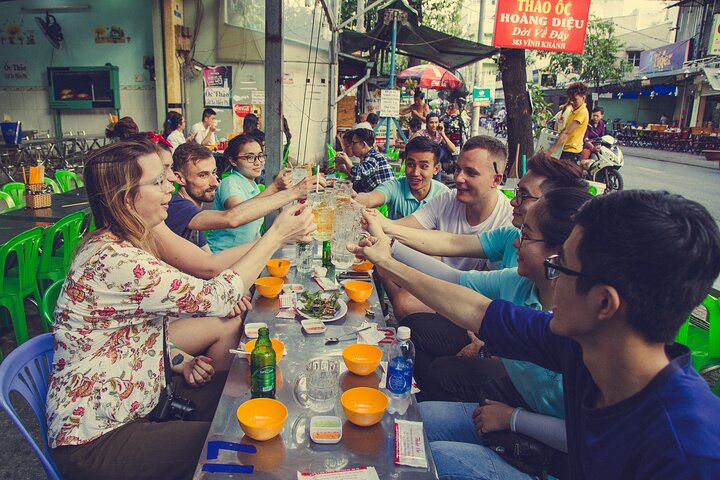
Ho Chi Minh City's food culture operates on the street. The best meals in Saigon are not served in restaurants — they're served on tiny plastic stools at sidewalk stalls by vendors who have been perfecting one dish for decades. A bowl of pho from a street cart at 6 AM, a banh mi from a roadside vendor at noon, a plate of com tam from a neighborhood joint at dinner — this is how Saigon eats, and how you should too.
Southern Vietnamese cuisine is distinct from the north: sweeter, more herbaceous, more generous with fresh ingredients. The herb plate that accompanies every meal is a garden in itself — Thai basil, sawtooth coriander, perilla, and mint piled high on a plate, free and unlimited.

Essential Saigon Dishes
1. Pho
Vietnam's national dish: rice noodles in a slow-simmered beef or chicken broth, topped with thinly sliced meat and served with a plate of fresh herbs, bean sprouts, lime, and chili. Saigon pho differs from Hanoi pho — the broth is slightly sweeter, the herb plate is larger, and hoisin and sriracha sauces are provided on the table.
Pho Hoa Pasteur on Pasteur Street has been serving pho since 1968 — their beef pho (VND 75,000) has a clear, deeply beefy broth with generous sliced beef and tendon. Pho Le on Nam Ky Khoi Nghia is a local favorite with fattier broth and more generous cuts (VND 65,000). For a budget option, any street stall with a queue of Vietnamese customers at 7 AM will serve excellent pho for VND 40,000-50,000.
2. Banh Mi
The world's greatest sandwich: a crispy French baguette filled with pate, mayo, sliced cold cuts, pickled daikon and carrot, cucumber, cilantro, and fresh chili. The bread is the key — Vietnamese baguettes use rice flour in the dough, creating an impossibly light, shattering crust with an airy interior.
Banh Mi Huynh Hoa on Le Thi Rieng Street is arguably the most famous banh mi in Vietnam — a massive, overstuffed sandwich (VND 47,000) packed with layers of pate and cold cuts. The queue stretches down the block from 3 PM onward. For something faster and cheaper, the roadside vendors throughout District 1 sell excellent banh mi for VND 20,000-30,000. Banh Mi 37 on Nguyen Trai serves a classic version for VND 25,000.
3. Com Tam (Broken Rice)
Saigon's signature lunch dish: broken rice grains (originally the rejected fragments from rice milling) topped with a grilled pork chop (suon nuong), shredded pork skin (bi), steamed egg and pork cake (cha trung), and served with pickled vegetables and fish sauce.
Com Tam Ba Ghien on Dang Van Ngu is the gold standard — the pork chop is marinated in lemongrass and fish sauce, charred over coals, and served over perfectly fluffy broken rice (VND 55,000 for the full plate). Com Tam Bui near Ben Thanh is another excellent option (VND 45,000). The dish is served at hundreds of roadside stalls — look for the ones with visible charcoal grills.
4. Bun Thit Nuong (Vermicelli with Grilled Pork)
Cold vermicelli noodles topped with charcoal-grilled pork, fresh herbs, pickled carrots, crushed peanuts, and fried shallots, dressed with nuoc cham (sweet fish sauce). It's the most refreshing meal in Saigon's heat — light, balanced, and deeply satisfying.
Every neighborhood has its bun thit nuong specialist. Prices range from VND 35,000-60,000 depending on location. The version with cha gio (fried spring rolls) added is worth the extra VND 10,000.
5. Ca Phe Sua Da (Iced Coffee)
Vietnamese coffee is not a drink — it's a ritual. Dark-roasted robusta beans brewed through a small metal drip filter (phin) over a glass of condensed milk, then poured over ice. The result is intensely strong, bittersweet, and addictive. A glass costs VND 20,000-35,000 at street cafes.
Cong Ca Phe serves excellent coconut coffee (VND 45,000) in communist-retro decor. The Workshop on Ngo Duc Ke Street is the specialty coffee scene's flagship, with single-origin Vietnamese coffee from VND 65,000. But the best ca phe sua da is from the nameless street vendors with a metal drip filter, a plastic stool, and a view of the traffic — VND 15,000-20,000.

Where to Eat: Neighborhood Guide
District 1 — Backpacker Area & Ben Thanh
The most accessible area for tourists. Bui Vien Street has cheap beer and street food but quality varies. The streets around Ben Thanh Market have better food — look for the com tam and bun stalls on Phan Boi Chau Street. Nguyen Hue Walking Street has more upscale options.
District 3 — Local Favorite
Where Saigon's middle class eats. Tree-lined streets with colonial villas converted into cafes and restaurants. Excellent pho, banh mi, and ca phe sua da at local prices. Less touristy, more authentic. The streets around Vo Van Tan and Nguyen Dinh Chieu are packed with options.
District 5 — Cholon (Chinatown)
Chinese-Vietnamese fusion food: hu tieu (pork and seafood noodle soup, VND 40,000), banh bao (steamed pork buns, VND 15,000), and dim sum at morning tea houses (VND 100,000-150,000 for a full spread). The food around Binh Tay Market is excellent and very cheap.
Ben Thanh Market
The market's interior food stalls serve decent banh xeo (crispy rice crepe, VND 30,000-50,000) and goi cuon (fresh spring rolls, VND 25,000 for two). Prices are higher than street stalls but the variety and convenience are good for first-timers wanting to try multiple dishes in one sitting.
Budget Eating Strategy
| Meal | Where | Cost |
|---|---|---|
| Breakfast | Pho or banh mi from street stall | VND 30,000-50,000 |
| Coffee | Ca phe sua da from street vendor | VND 15,000-25,000 |
| Lunch | Com tam or bun thit nuong | VND 40,000-60,000 |
| Dinner | Street food or local restaurant | VND 50,000-80,000 |
| Daily Total | VND 135,000-215,000 |

The golden rule of Saigon eating: if the stool is plastic and the kitchen is on the sidewalk, you're probably about to eat something incredible for almost nothing.
Street Food & Markets in Ho Chi Minh City
Saigon's street food scene is best understood as a map of micro-specialists. One vendor cooks nothing but banh cuon (steamed rice rolls) from 6 to 10 AM, then disappears. Another sells only banh trang tron — a tangled snack of torn rice paper, dried shrimp, quail eggs, green mango, and chili oil — from a cart that appears in the same spot at 3 PM daily. The city operates on invisible schedules that locals know intuitively; the visitor's job is to explore blocks, follow smells, and eat whatever looks fresh and busy.
Ben Thanh Market is the most famous and the most inflated. The food stalls inside the main hall sell decent banh xeo and goi cuon, but prices are 30-50% above street rates and vendors are accustomed to haggling. The street stalls that ring the outside of the market — particularly on the Pho Duc Chinh side — are far better: com tam for VND 35,000-45,000, banh mi from VND 20,000, and freshly squeezed sugarcane juice (nuoc mia) for VND 10,000-15,000.
Binh Tay Market in Cholon (District 5) is a wholesale market primarily used by restaurants and food businesses, but the surrounding streets are among Saigon's best eating zones. Banh bao (steamed pork buns, VND 10,000-15,000), hu tieu (clear pork and seafood noodle soup, VND 40,000-50,000), and chao long (rice porridge with pork offal, VND 25,000-35,000) dominate this neighbourhood. The morning eating window here is 6-10 AM.
Tan Dinh Market in District 3 is Saigon's most authentically local covered market. The food stalls in the rear section serve bun bo Hue (spicy central Vietnamese beef noodle soup, VND 40,000-55,000) and mien ga (glass noodle soup with chicken, VND 35,000-45,000) to a crowd of neighbourhood residents who have been eating here for years. No tourist menus, no English — point at what the table next to you is eating.
The street food corridor along Vinh Khanh Street in District 4 is Saigon's seafood night market. From 5 PM onwards, vendors grill whole clams (ngheu nuong mo hanh, VND 50,000-80,000 per plate), king prawns, and river fish over charcoal. The street runs for several blocks and the smoke alone is worth the trip. Plastic tables overflow onto the pavement, cold beer arrives without ordering, and the bill is calculated on a trust system — vendors count the empty shells and beer bottles at the end.
Nguyen Thuong Hien Street in District 3 operates as an informal food street most evenings, with vendors positioning their carts along both sides of the block from around 5 PM. Look for the banh trang nuong (Dalat-style grilled rice paper with egg, dried shrimp, and spring onion, VND 15,000-20,000) vendor — a snack that originated in the Central Highlands but has been enthusiastically adopted by Saigon's street food scene.
Ready to eat? Find hotels in Ho Chi Minh City on JustCheckin.