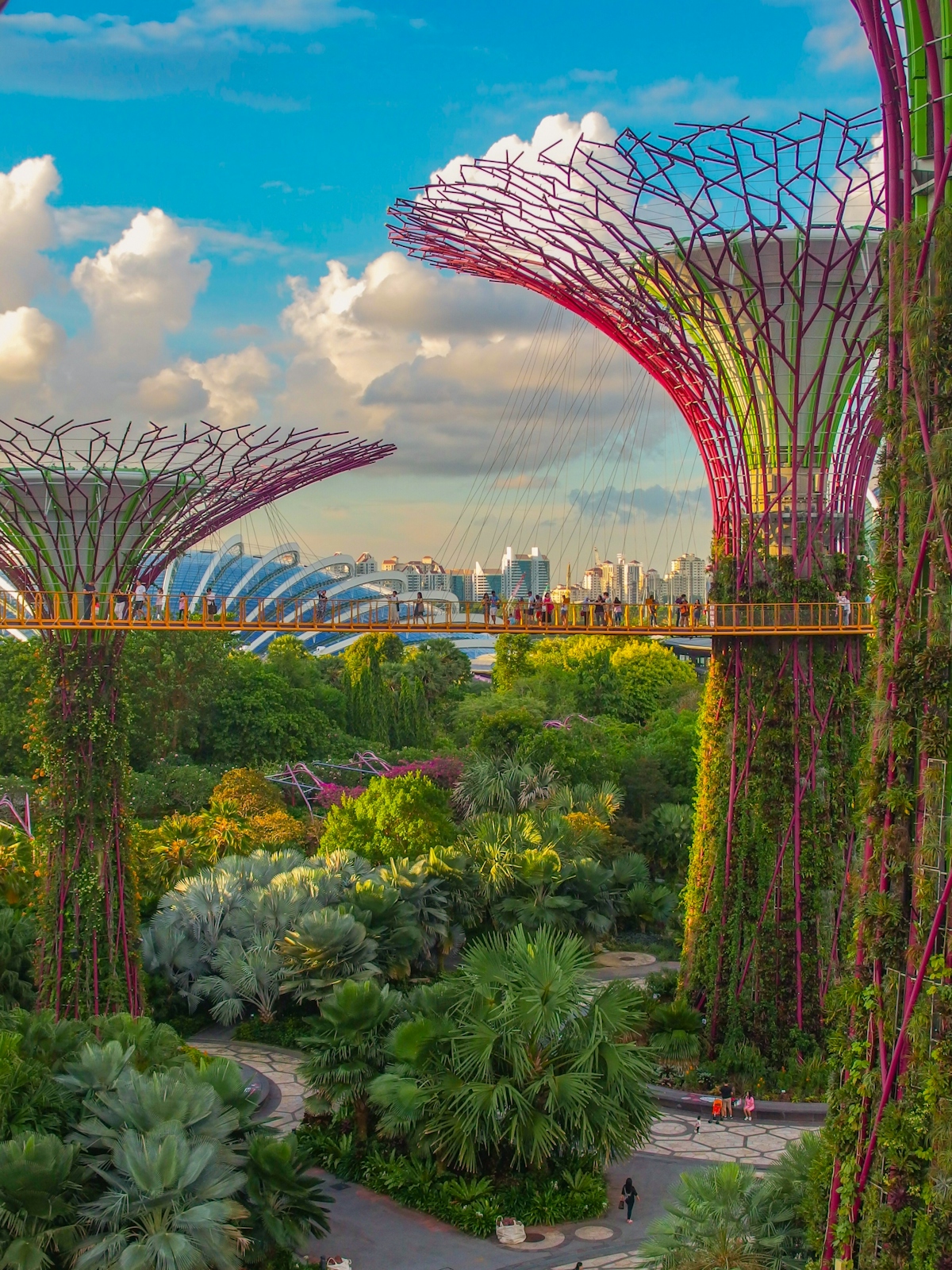
Singapore's reputation as a gleaming, expensive city-state of shopping malls and luxury hotels obscures something that longer-term residents know well: beneath the polished surface lies a city of extraordinary hidden depth. Beyond Marina Bay Sands, Sentosa Island, and the Merlion selfie spot, Singapore contains remnants of kampong villages, abandoned military installations, art deco neighborhoods that predate independence, a free mythology theme park that would be illegal in most other countries, nature reserves with more biodiversity per square kilometer than many national parks, and heritage neighborhoods where Peranakan, Malay, Indian, and Chinese cultures have layered on top of each other for centuries.
These ten hidden gems represent the Singapore that doesn't appear on the tourist bus route — places that are free or nearly free, easily accessible by MRT, and offer encounters with a Singapore that is wilder, stranger, and more historically complex than its sanitized image suggests.
What makes Singapore's hidden gems particularly rewarding is the contrast factor. The city's main tourist attractions are polished to a high sheen — everything is designed, maintained, and optimized for the visitor experience.
The places on this list are different. They're rough-edged, overgrown, eccentric, or simply overlooked — and that rawness is precisely what makes them memorable. In a city where everything seems controlled, these are the places where Singapore gets wonderfully, unexpectedly weird.

1. Tiong Bahru: Art Deco Village in a Modern City
Tiong Bahru is Singapore's oldest public housing estate, built in the 1930s by the Singapore Improvement Trust, and it looks like nothing else in the city.
The low-rise art deco apartment blocks — curved balconies, streamlined facades, porthole windows, pastel colors — were designed by the same architectural movement that shaped Miami Beach and Shanghai's Bund, but here they sit in a quiet residential neighborhood surrounded by tropical trees, wet markets, and a growing scene of independent cafés, bakeries, and bookshops that has made Tiong Bahru the darling of Singapore's creative class.
The neighborhood rewards slow, aimless walking. Start at Tiong Bahru Market, a traditional wet market and hawker center where residents have been buying groceries and eating breakfast for decades — the chwee kueh (steamed rice cake with preserved radish, S$1.50) at Jian Bo is legendary, and the market's hawker center has multiple stalls serving excellent, affordable food.
From there, walk the quiet residential blocks, noting the art deco details — the spiral staircases, the flat roofs designed for growing vegetables, the pre-war shophouses on Seng Poh Road. Books Actually (now BooksActually, if it has relocated again — check current location) is one of Singapore's most beloved independent bookshops.
Plain Vanilla Bakery serves some of the best cupcakes in the city. Forty Hands coffee is a neighborhood institution. The entire experience — architecture, food, coffee, browsing — costs next to nothing and delivers a Singapore that feels genuinely village-like in scale and temperament.
2. Pulau Ubin: Singapore's Last Kampong
Pulau Ubin is a small island off Singapore's northeast coast that feels like a time capsule — the last place in Singapore where you can see what the entire country looked like before independence, before development, before the glass towers and the expressways.
The island is home to a handful of permanent residents (estimates vary from 30 to 100), abandoned granite quarries that have flooded into luminous turquoise lakes, mangrove swamps, traditional Malay kampong houses, wild boars, monitor lizards, and the Chek Jawa Wetlands, a pristine coastal wetland with a boardwalk that passes through six different ecosystems in under a kilometer.
Getting there is part of the experience: take the MRT to Tanah Merah, then bus 2 to Changi Point Ferry Terminal, then a bumboat (small motorboat, S$4 each way) that departs when it fills up (usually 12 passengers). On the island, rent a bicycle (S$8-15 for the day) from one of the rental shops near the jetty and spend 4-6 hours cycling the island's dirt roads and trails.
The Chek Jawa Wetlands are the highlight — the boardwalk extends over the water and through the mangroves, with information panels explaining the ecology. The quarries (Pekan Quarry and Ubin Quarry) are hauntingly beautiful — abandoned excavation sites where nature has reclaimed the stone and filled the pits with jade-green water.
Bring water, sunscreen, and snacks (there are a few basic shops on the island, but options are limited). The island has no cars, no malls, no air conditioning, and no schedule — it's Singapore at its most raw and its most peaceful, and it costs under S$30 for a full day including transport and bicycle rental.
3. Henderson Waves: The Bridge in the Sky
Henderson Waves is a pedestrian bridge connecting Mount Faber Park to Telok Blangah Hill Park — and it's one of the most striking pieces of public infrastructure in Asia. The bridge undulates in a wave pattern 36 meters above Henderson Road, its curved ribs creating sheltered alcoves with built-in seating where you can sit and watch the forest canopy at eye level.
At 274 meters long, walking across it takes just 5-10 minutes, but the experience — suspended in the treetops, the city visible through gaps in the foliage, the curve of the bridge creating constantly shifting perspectives — is mesmerizing.
Henderson Waves is best experienced as part of the Southern Ridges trail, a 10-km walking route that connects HortPark, Kent Ridge Park, Telok Blangah Hill Park, Mount Faber Park, and the Marang Trail. The full walk takes 3-4 hours and passes through mature secondary forest, manicured gardens, and multiple viewpoints over the southern coast and Sentosa Island.
The trail is entirely free, well-maintained, and mostly shaded. The section from Henderson Waves to the Forest Walk (an elevated steel walkway through the forest canopy) and on to Alexandra Arch (another architectural bridge) is the most spectacular — three pieces of remarkable public architecture connected by forest trail, all free, all within a few kilometers of the city center.


4. Haw Par Villa: The World's Strangest Theme Park
Haw Par Villa is free, it's bizarre, and there is genuinely nothing else like it anywhere in the world. Built in 1937 by the brothers who created Tiger Balm, this hillside park contains over 1,000 statues and 150 dioramas depicting scenes from Chinese mythology, Confucian morality tales, and Buddhist and Taoist legends — rendered in vivid, sometimes grotesque, always extraordinary detail.
The centerpiece is the Ten Courts of Hell, a walk-through underground exhibit depicting the punishments awaiting sinners in the Chinese afterlife: people being sawn in half, ground by stone mills, fried in oil, thrown into forests of swords, and devoured by animals. It's graphic, detailed, and presented with the earnest didactic intention of a Sunday school lesson — each court's sign explains which sins lead to which punishments.
Beyond the Ten Courts, the park sprawls across a hillside with hundreds of tableaux — the Journey to the West characters, the Eight Immortals, the 24 Filial Piety stories, and assorted scenes of tigers fighting, demons feasting, and sages meditating. The statues are in varying states of repair, the paint is fading in the tropical sun, and the overall effect is somewhere between a folk art museum, a religious theme park, and a fever dream.
Haw Par Villa is free, open daily, and accessible via Haw Par Villa MRT station (Circle Line). Allow 1-2 hours to explore the entire park.
5. Bukit Timah Nature Reserve: Rainforest in the City
Bukit Timah Nature Reserve protects the summit of Bukit Timah Hill (163 meters), the highest point in Singapore, and the mature tropical rainforest that covers it. The reserve contains more tree species in its 163 hectares than the entire North American continent — a staggering concentration of biodiversity that's a relic of the primary forest that once covered the entire island.
The main trail to the summit is a paved road (1.5 km) that climbs steeply through dense forest, passing enormous dipterocarps, strangler figs, and the occasional long-tailed macaque troop. Side trails branch into deeper forest with unpaved paths and thicker vegetation.
The experience of walking through genuine tropical rainforest — the canopy closing overhead, the calls of birds and insects, the humid air heavy with the smell of decomposing leaves and flowering trees — is remarkable anywhere, but particularly so when you remember that you're in one of the most densely urbanized countries on earth, and a subway station is 15 minutes' walk away. Bukit Timah Nature Reserve is free, open daily 7 AM to 7 PM, and accessible via Beauty World MRT station (Downtown Line).
The summit hike takes 30-45 minutes each way. Combine it with a walk through the adjacent Dairy Farm Nature Park and the Wallace Trail (named for Alfred Russel Wallace, who collected specimens here in the 1850s) for a half-day of forest immersion.

6. Joo Chiat and Katong: Peranakan Shophouse Paradise
Joo Chiat and the adjacent Katong neighborhood form the heart of Singapore's Peranakan (Straits Chinese) culture — a unique hybrid of Chinese, Malay, and European influences that developed over centuries among the Chinese communities of the Straits Settlements. The architecture is the immediate draw: rows of beautifully restored shophouses with ornate facades in pastel colors, intricate tile work, carved wooden doors, and the distinctive Peranakan aesthetic that blends Chinese motifs with Malay craftsmanship and Art Nouveau European design.
Koon Seng Road is the most photographed street — a row of pastel shophouses with elaborate tile facades that look like a jewelry box opened flat.
Beyond the architecture, Joo Chiat is a living neighborhood with an excellent food scene. 328 Katong Laksa (or its neighbor Janggut Laksa) serves Katong laksa — a rich, spicy coconut curry noodle soup that's the neighborhood's signature dish (S$5-7).
The Peranakan restaurants along Joo Chiat Road serve nyonya cuisine — a distinctive Peranakan cooking tradition that combines Chinese ingredients with Malay spices and techniques. Kim Choo Kueh Chang sells traditional Peranakan rice dumplings and operates a small museum about Peranakan culture (free).
The neighborhood also has a growing independent café and bar scene, particularly along Joo Chiat Road and the side streets.
7. Gillman Barracks: Contemporary Art in Colonial Barracks
Gillman Barracks is a former British military compound from 1936, a cluster of white colonial-era barracks buildings set among mature trees on a quiet hillside in the Alexandra area. Since 2012, the barracks have been repurposed as a contemporary art cluster — multiple international galleries have set up in the renovated military buildings, creating a concentrated art precinct that's free to browse and mercifully uncrowded compared to Singapore's major museums.
Galleries rotate exhibitions regularly, with a focus on contemporary Southeast Asian art — painting, sculpture, installation, video, and photography from the region's most interesting emerging and established artists. STPI Creative Workshop is one of the anchor tenants, hosting exhibitions and a working print and paper workshop.
ShanghART Singapore shows major Chinese contemporary artists. The barracks themselves are architecturally interesting — the clean lines of tropical colonial military architecture, designed for ventilation and shade, now house white-cube gallery spaces.
The grounds are peaceful for walking, and Colbar, a café in a former colonial officers' mess hall, serves food and beer in a setting unchanged since the 1950s. Free entry to all galleries, open Tuesday to Sunday.
Take the MRT to Labrador Park station (Circle Line) and walk 10 minutes.
8. Rail Corridor: Walking the Old Railway
The Rail Corridor (formerly the Green Corridor) is a 24-kilometer linear park that follows the route of the old Keretapi Tanah Melayu (KTM) railway line that once connected Singapore to Malaysia.
When the railway ceased operations in 2011 and the land was returned to the Singapore government, the corridor became an informal walking and cycling path through the heart of the island — a continuous green strip passing through residential neighborhoods, forests, and former railway infrastructure that is gradually being formalized into a public park while preserving its wild, overgrown character.
The full corridor runs from Woodlands in the north to the former Tanjong Pagar Railway Station in the south, passing through some of Singapore's least-visited landscapes: the Bukit Timah truss bridge (a heritage steel railway bridge over Bukit Timah Road), the Clementi Forest (a patch of mature secondary forest), and stretches of the route that are still overgrown enough to feel like walking through rural Malaysia rather than urban Singapore. The southern sections near Holland Village and Buona Vista are the most popular for walkers.
The Tanjong Pagar Railway Station at the southern terminus is a beautiful Art Deco building from 1932 — currently undergoing redevelopment but visible from outside. Access points are numerous — the Rail Corridor intersects with several MRT stations, making it easy to walk a section rather than the entire 24 km.

9. Coney Island: Wild Beach Off the Grid
Coney Island (officially Coney Island Park) is a 50-hectare island off Singapore's northeastern coast, connected to the mainland by a bridge at each end. Unlike Sentosa — Singapore's manicured resort island — Coney Island is deliberately left wild: unpaved trails wind through casuarina and coconut plantations, mangrove edges, and open grasslands where long-tailed macaques, otters, and over 80 bird species have been recorded.
The beaches are natural (no imported sand, no beach bars), the trails are rustic, and the entire island has an atmosphere of being slightly forgotten by a city that usually polishes everything to a shine.
Access is by foot or bicycle only — no motorized vehicles are allowed on the island. The western entrance connects to Punggol Promenade (walkable from Punggol MRT station, about 15 minutes), and the eastern entrance connects to the Lorong Halus Wetland via a bridge.
Cycling is the best way to explore — bring your own or rent from the bicycle shops near Punggol Waterway. The beaches on the northern shore face the Johor Strait (toward Malaysia) and are quiet, natural, and perfect for a picnic.
The Casuarina Beach is the most accessible, with a grove of casuarina trees providing shade. Free entry, open 7 AM to 7 PM daily.
10. Labrador Nature Reserve: WWII Tunnels and Coastal Forest
Labrador Nature Reserve is a small but historically rich park on Singapore's southern coast that combines mature coastal forest, rocky shoreline, and World War II military heritage in a compact area that most tourists overlook entirely.
The reserve sits on a promontory that was fortified by the British in the late 19th century and saw action during the Japanese invasion of Singapore in 1942 — the remains of gun emplacements, ammunition bunkers, and a network of tunnels (the Labrador Secret Tunnels) are preserved within the park.
The tunnels were built in the 1880s as a network of underground passages connecting gun positions, command posts, and ammunition stores on the headland. They were used during World War II and then sealed for decades before being partially opened to the public.
The main tunnel complex is accessible via a guided tour (check NParks for current schedule and availability) or viewable from outside. The gun emplacements — massive concrete positions built into the cliff face, now overgrown with tropical vegetation — are freely accessible along the park's walking trails.
Beyond the military heritage, Labrador Nature Reserve contains one of Singapore's last stretches of coastal cliff forest — a habitat type that has been almost entirely destroyed by development elsewhere on the island. The Berlayer Creek Boardwalk extends through a mangrove area at the park's eastern edge, and the rocky shoreline reveals tide pools with marine life at low tide.
The park is free, quiet on weekdays, and accessible via Labrador Park MRT station (Circle Line). Combine with a visit to nearby Gillman Barracks for a full half-day of hidden Singapore.
South coast day: Henderson Waves + Southern Ridges walk + Labrador Nature Reserve + Gillman Barracks.
Northeast day: Pulau Ubin (full day) or Coney Island + Punggol Waterway.
Central culture day: Tiong Bahru + Haw Par Villa + Rail Corridor section.
East side day: Joo Chiat/Katong + East Coast Park.
Nature day: Bukit Timah Nature Reserve + Dairy Farm Nature Park. Each grouping works as a full day of free or nearly-free exploration.
These ten places reveal a Singapore that contradicts its own carefully curated image — a city that contains genuine wilderness, military history, architectural eccentricity, and cultural layering that the Marina Bay skyline and the Orchard Road shopping malls never hint at. Each hidden gem is free or nearly free, accessible by MRT, and offers an experience that no amount of money can buy at the tourist attractions: the sensation of discovering something that most visitors never see, in a city that seems designed to show you only its polished face.
The hidden Singapore isn't hidden because it's difficult to find — it's hidden because the obvious Singapore is so overwhelming that most visitors never think to look behind it.
Singapore Budget Travel Guide: Affordable in the Lion City Singapore Food Guide: Hawker Centers and Beyond Singapore 4-Day Itinerary: The Complete Experience


